
Step 1
Site Consultation and Design
We walk the property with the homeowner, read the drainage and shade conditions, understand the use scenario, and produce a design that responds to what the site actually needs.
Loading...
Service Detail
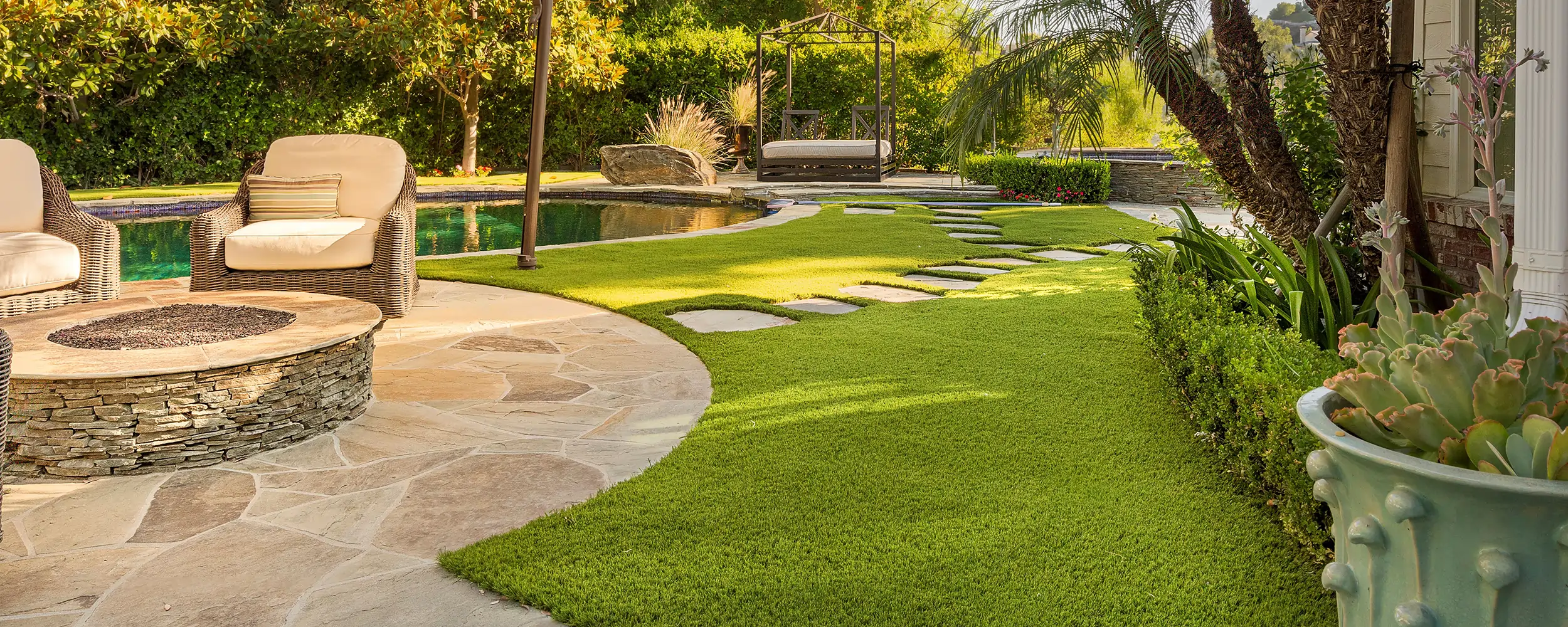
Residential artificial turf installation for Lake Conroe and Montgomery County homeowners — designed around how your yard actually lives.
Main Introduction
The homeowner who calls us for a residential installation has usually been thinking about it for a while — they've watched the St. Augustine struggle through a third season under the pine trees, or they've filled in the deer-path bare spots twice and watched them come back, or they've been apologizing for the state of the backyard before every party. The conversation that brought them to us is the one where they stopped calculating the cost of continuing to fight the conditions and started asking what winning the fight actually looks like.
Residential artificial turf installation in the Lake Conroe area means something specific — it's not a suburban Phoenix installation where the driver is desert landscaping, and it's not a Pacific Northwest installation where moss and shade are the enemy. Here, the enemy is the combination of clay-soil drainage problems, pine-needle accumulation, deer pressure from the Sam Houston National Forest fringe, lakeside humidity that creates moisture-management requirements, and shading from mature canopy trees that have won their territory from grass.
Artificial Grass of Conroe was built in this specific environment. The owner spent years as a golf-course superintendent on properties where reading the site conditions — understanding the drainage story, the shade canopy schedule, the soil profile, the use intensity at different points of the surface — determined whether an installation succeeded or failed. That analytical habit carries into every residential project we do.
A Conroe-area residential installation might be a fourteen-hundred square foot backyard in Graystone Hills that needs to handle two Labs and three kids simultaneously without degrading into a mud situation. Or it might be a five-thousand square foot lakefront lot in Bentwater where the putting green and the party lawn and the pool-deck transition all need to work together as a single designed space. The project scope varies; the approach — read the site, design for the conditions, install with precision, hand over with clear care instructions — stays consistent.
What Is Included
Every residential installation begins with a site consultation that goes beyond square-footage measurement. We're reading the drainage story, understanding the canopy shade schedule, documenting the use patterns that the yard needs to support, and listening to the homeowner's picture of what the finished space should feel like. That conversation produces a scope and a design that actually matches the site rather than fitting a template to it.
Base preparation is where most residential installations are won or lost. For the clay-heavy soils throughout much of Montgomery County, that means excavating far enough to get below the seasonally saturated zone, bringing in a drainage-quality aggregate that moves water vertically, and compacting in passes that produce a stable base without creating hydraulic barriers. For lake-adjacent properties, we're also shaping the sub-base grade to direct runoff constructively rather than allowing it to pool at the lowest elevation point.
Turf selection is a conversation rather than a product pick. Pile height, fiber material, infill type, and color choice all interact with the specific conditions of the installation — a shaded yard doesn't need the same UV-resistance specification as a full-sun installation; a pet-use zone needs different infill antimicrobial characteristics than a purely aesthetic lawn. We present those options in context rather than defaulting to a catalog.
Installation moves through a clear sequence — base, turf, seam, edge, infill, groom — with cleanup at each phase so the yard is livable even while the project is in progress. Closeout includes a hands-on walkthrough where we demonstrate the specific care tasks the installation requires.
Process Steps
Step 1
We walk the property with the homeowner, read the drainage and shade conditions, understand the use scenario, and produce a design that responds to what the site actually needs.
Step 2
Excavation to the appropriate depth for the soil profile found, aggregate installation, compaction, and sub-base grade shaping for drainage direction.
Step 3
Panels are positioned with grain direction optimized for sight lines, seams are placed for minimum visibility, and cut lines are scored to match hardscape geometry precisely.
Step 4
Perimeter anchoring, edge-transition finishing, and infill distribution — with antimicrobial specification in pet-use zones and standard specification elsewhere.
Step 5
Final power brush, cleanup, and a site-specific care walkthrough that covers the seasonal maintenance tasks specific to this installation's conditions.
Use Cases
Residential installations throughout the Lake Conroe and Montgomery County service area address the full range of backyard challenges: shade-killed grass under pine canopy, deer-traffic bare spots, pet-use mud zones, party-lawn drainage failures, and multi-use yards where children's activity and adult entertaining share the same surface.
Properties in North Conroe, Willis, and Huntsville that back up against the Sam Houston National Forest fringe — where the pine canopy creates conditions that grass cannot survive — need a surface that doesn't depend on photosynthesis. Synthetic turf under pine trees is a permanent resolution rather than a seasonal battle.
The backyard party-lawn and fire-pit surrounds at Bentwater, April Sound, Grand Harbor, and Walden on Lake Conroe are the social center of the lake-house experience. A surface that drains quickly after rain, holds up under party-scale foot traffic, and looks clean under evening string lights changes the relationship between the house and the entertaining calendar.
A yard with two or three large dogs develops bare, compacted, odor-producing zones within months of the first sod installation. Synthetic turf with antimicrobial infill and a proper drainage base addresses all three problems simultaneously — the surface stays consistent, drainable, and manageable regardless of pet use intensity.
Kids' birthday parties, soccer practice, trampoline zones, and the hundred small collisions of family backyard life compress and tear traditional grass in predictable patterns. A surface designed for activity intensity stays consistent through all of those uses without seasonal recovery cycles.
Why Choose
The golf-superintendent background that drives our company's approach produces a specific way of seeing a residential yard: not as a consumer product installation but as a surface management problem. Before we install anything, we read the site. We understand what the drainage is actually doing, what the shade canopy is actually creating, what the use pattern is actually requiring. That read is what produces an installation that holds up rather than one that looks good in the first photos and starts showing problems by the second summer.
Montgomery County conditions are specific. The pine needle drop, the deer pressure, the clay-soil moisture retention, the lakeside humidity that distinguishes this area from drier Texas regions — these are conditions that an installer who learned turf in Phoenix or Las Vegas hasn't worked with. We have. Every installation decision we make is informed by what we've observed over years of work in exactly these conditions.
The residential work we do is backed by a care documentation approach that treats each installation as a specific site rather than a product with a generic manual. The homeowner who has Bentwater pine trees and a Lab gets different seasonal care guidance than the homeowner in Oak Ridge North with live-oaks and a water feature. That specificity is the difference between an installation that lasts and one that starts generating questions by year three.
Pricing Factors
Residential pricing reflects the actual scope rather than a per-square-foot formula. A straightforward flat-lot installation in a standard soil profile prices differently than a lakefront property with grade change, drainage design, and pool-coping transitions. We produce itemized scope estimates so the homeowner understands what each element contributes to the total.
Service Area Coverage
Residential artificial turf installation is available throughout the Lake Conroe service area, including Conroe, Bentwater, April Sound, Walden on Lake Conroe, Grand Harbor, Corinthian Point, Graystone Hills, River Plantation, North Forest, The Woodlands, Montgomery, Willis, Westwood Shores, Lake Conroe Hills, Panorama Village, Magnolia, Spring, Tomball, Porter, New Caney, Huntsville, and all surrounding Montgomery County communities.
Related Services
Frequently Asked Questions
Grain direction, edge treatment, and pile selection all factor into needle-management performance. We orient the installation so routine blow-and-go cleanup moves debris to the perimeter rather than embedding it in the pile.
Yes, significantly — the sub-base grade design is shaped to direct runoff constructively rather than letting it pool at the lowest elevation or accelerate off the property.
With proper antimicrobial infill and a drainage-quality base that moves liquid quickly, yes. The installation protocol for heavy pet use is different from a decorative lawn, and we specify for the actual use.
That's one of our most common Lake Conroe backyard projects. The two elements are designed together so the transition between them reads as an integrated outdoor space rather than two separate installations.
Closeout includes a written care guide specific to your installation — the seasonal tasks that your particular canopy conditions, soil profile, and use pattern require, not a generic brochure.
Final CTA
Submit the form with service type, property address, and timeline details. You can also call directly for scheduling support.
Call