Step 1
Golf Game and Design Consultation
We talk about your game — the courses, the distances, the shot shapes — before we talk about the surface. The design emerges from your practice priorities, not a standard template.
Loading...
Service Detail
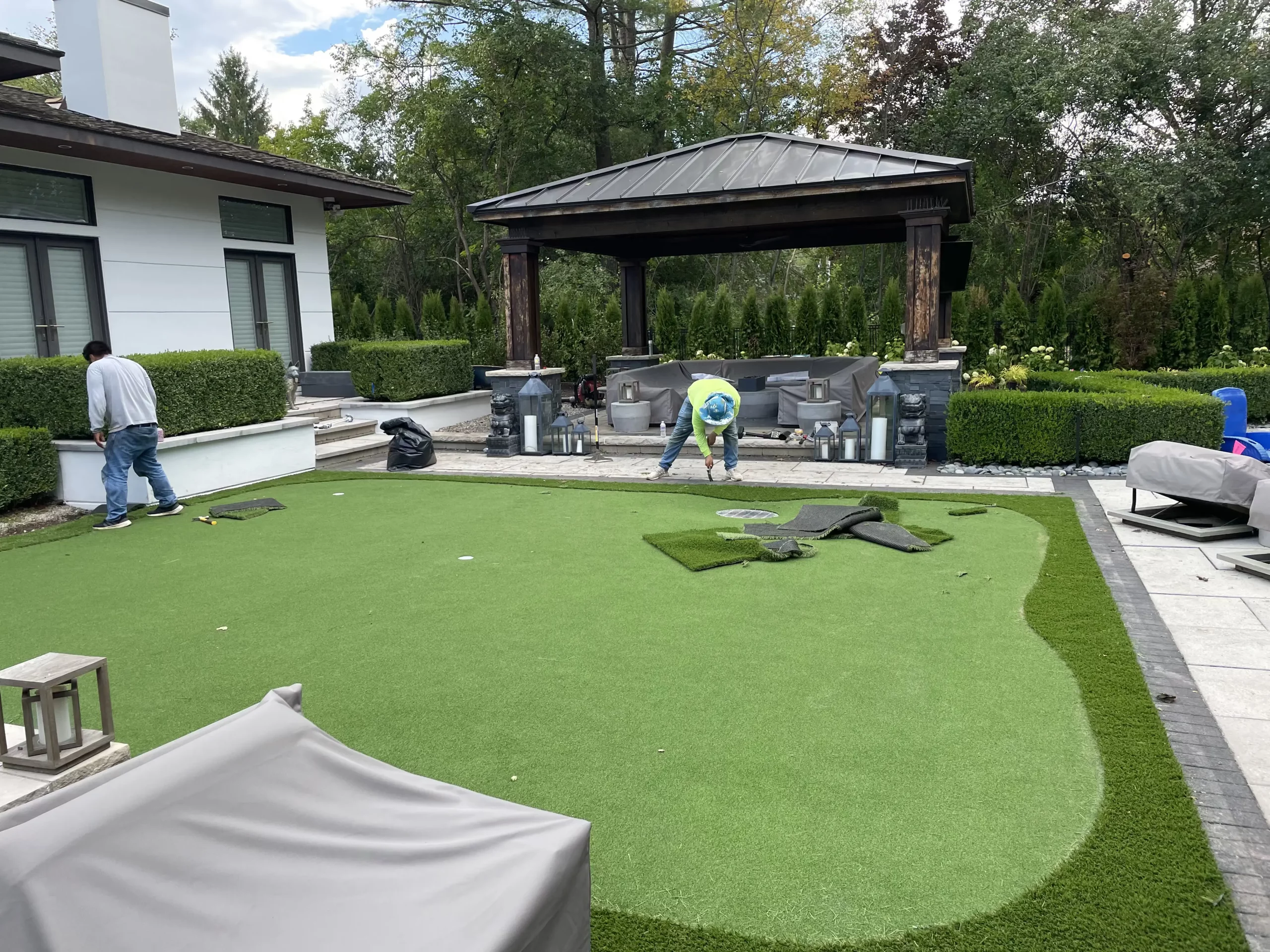
Custom backyard putting green design and installation from a former golf-course superintendent — real break lines, real elevation, real practice.
Main Introduction
There is a moment in a round of golf — usually on a Saturday morning at Bentwater, or at Augusta Pines, or at one of the Sam Houston area courses where the greens run a little faster in fall — when a homeowner three-putts a hole they know they should have read correctly, and the thought surfaces: I should have put that green in the backyard two years ago. By the time they get home, the idea is no longer a passing thought.
Artificial Grass of Conroe was built around exactly this scenario. The owner spent years as a golf-course superintendent, which means years of understanding how greens are designed to challenge golfers — the slope percentages that create memorable breaks, the relationship between drainage direction and playing direction, the way sub-surface contour design produces the experience of a putt that reads differently from the pin than it does from off the green. That knowledge doesn't disappear when the installation medium changes from bent-grass to synthetic fiber. It informs every design decision we make on a backyard putting green.
The difference between an Artificial Grass of Conroe putting green and a flat-surface-with-cups installation is the difference between practice and habit. A flat surface gives you repetition; a surface with designed elevation changes, real break lines, and multiple cup positions that create different challenge scenarios gives you the kind of practice that transfers to on-course performance. The breaks you rehearse at home are the breaks that become intuitive on the course.
Backyard putting greens in the Lake Conroe community serve a specific lifestyle. The homeowner at Bentwater who plays twice a week, the April Sound retiree who has finally had time to focus on the game they've been playing casually for thirty years, the Grand Harbor family where dad's chip-and-putt habit is the thing that makes the backyard feel complete — these are the customers whose backyards we've changed. The investment pays in rounds played and scores improved, not just in backyard aesthetics.
What Is Included
An Artificial Grass of Conroe putting green project begins with a design consultation, not a product quote. We want to understand the homeowner's game before we talk about the surface — the courses they play regularly, the distances and shot types they need to practice most, whether approach shots and chipping are part of the scope or just putting, and how the green will coexist with the rest of the backyard's entertaining and living uses.
From that conversation, we produce a green layout that includes the footprint shape, cup position options, and — most importantly — the sub-surface elevation profile. The breaks are designed on paper before any installation begins. We sketch the slope percentages, identify the dominant break line from each cup position, and plan how the drainage direction relates to but is independent of the playing breaks. A green that drains toward the back-left can still have a right-to-left break on the front-right surface; those are separately engineered.
Base preparation for a putting green is more intensive than for a standard lawn installation. The sub-surface shaping requires precise compaction at each elevation transition, with the grade changes confirmed before turf goes down. We use a surveying approach — not sophisticated equipment, but methodical measurement — to verify that the designed elevation changes are actually present in the compacted base before any turf is placed.
Turf selection for putting greens is a specific conversation about green speed. The pile height and fiber material interact with infill depth to produce a speed range that we can calibrate to match the courses the homeowner plays. Bentwater's greens run fast in the fall; a homeowner who practices for that speed at home will be prepared for it on the course.
Process Steps
Step 1
We talk about your game — the courses, the distances, the shot shapes — before we talk about the surface. The design emerges from your practice priorities, not a standard template.
Step 2
The break lines are designed on paper first — slope percentages, dominant break direction from each cup position, drainage direction. This design is what gets built into the base.
Step 3
Excavation, aggregate placement, and compaction are done in passes, with elevation transitions verified by measurement before turf is placed. The base is the green — turf just makes it visible.
Step 4
The selected turf and infill depth combination is installed and calibrated to the target green speed. We roll the surface and adjust infill distribution before marking it complete.
Step 5
Cup locations are set per the design, fringe treatment is installed to match the aesthetic context, and the transition to adjacent lawn or hardscape surfaces is finished cleanly.
Use Cases
Backyard putting greens throughout the Lake Conroe and Montgomery County area serve experienced golfers who want daily practice, families who want an outdoor game element, and waterfront properties that use the green as a centerpiece of the backyard entertainment experience.
The Bentwater or Grand Harbor golfer who plays multiple times per week and wants their home green to replicate the challenge conditions of their regular courses. Real elevation changes, real break lines, green speed calibrated to the courses they play.
A combined putting surface with an adjacent chipping area — multiple cup positions accessible from chip-distance, a fringe zone that creates pitch-shot scenarios, and the whole layout designed to simulate the short-game situations a golfer encounters most frequently.
The putting green as social anchor — a feature that draws guests to the backyard, creates friendly competition at gatherings, and gives the outdoor space a purposeful character that goes beyond a party lawn.
Families where a parent or child is developing their game find a backyard green an especially practical investment — access to putting practice at the natural moments between school, dinner, and other activities, without the logistics of a club visit.
Why Choose
The golf-superintendent background that defines Artificial Grass of Conroe is the specific differentiator for putting green design. Spending years managing real greens — planning renovation work, reading how contour design affects the challenge of a hole, understanding the relationship between drainage engineering and playing conditions — produces a perspective that a synthetic installer who learned putting greens from a product manual simply doesn't have.
The breaks we design are real breaks, not decorative. A homeowner who puts the corner break on their backyard green one hundred times will begin to read the same break pattern when they encounter it on their home course. That transfer is the point.
The Lake Conroe golf community also provides a context for our design conversations that most installers in other markets lack. When we discuss green speed with a Bentwater member, we're talking about actual greens they play. When we discuss the kind of break that costs a stroke at Augusta Pines, we know what that break looks like. That shared language makes the design consultation more productive.
Pricing Factors
Putting green pricing reflects the design and base preparation intensity that a proper installation requires. A flat surface with two cups and no engineering prices differently than a contoured green with four cups, a chip zone, and a fringe detail that integrates with an existing hardscape. We produce detailed estimates that separate the design, base, turf, and finishing phases so the homeowner understands what each element represents.
Service Area Coverage
Synthetic putting green design and installation is available throughout the Lake Conroe service area — Bentwater, Grand Harbor, April Sound, Walden on Lake Conroe, Corinthian Point, Westwood Shores, Lake Conroe Hills, The Woodlands, Panorama Village, Conroe, Montgomery, Willis, and all surrounding Montgomery County communities.
Related Services
Frequently Asked Questions
The sub-surface elevation profile. The breaks are designed on paper before any installation begins, engineered into the compacted base itself rather than simulated with mounded turf. A homeowner practicing on a designed green is rehearsing real break patterns.
Yes. The pile height and infill depth combination produces a speed range that we calibrate to match the Stimpmeter readings of the courses you play regularly.
We approach short-game facility design the way a golf architect would approach a par-3 hole — multiple approach distances, varied pin positions, and the spatial relationship between chipping zones and the putting surface all designed together.
Yes. The transition between an existing turf lawn and a new putting surface can be designed as a fringe treatment that reads as an integrated element rather than an addition.
Three or four is a common minimum for a practice-focused green — enough to offer genuinely different approach angles and break scenarios. The right number depends on the green's size and shape.
For entertainment use, we design for visual appeal and casual playability rather than competitive practice specificity — more gentle breaks, more forgiving cup locations, and surface speed calibrated for fun rather than tour preparation.
Final CTA
Submit the form with service type, property address, and timeline details. You can also call directly for scheduling support.
Call